
Adventures in Gaming III

In the CDC game, players complete missions to cure outbreaks while also collecting badges and rewards for their efforts.
For my third gaming journal, I decided to consider a game that I might actually choose to use in my classroom., OUTBREAK:CDC 24/7 Saving Lives, Protecting People. This game utilizes real-world inspired disease outbreaks and places the player in the role of a disease researcher working for the CDC. I am impressed with the quality of the game which uses a decision-making approach to advance the game play. The game is effective in that it requires players to combine their existing knowledge and research skills together in order to achieve their goal of stopping/curing various disease outbreaks. While researchers such as Nino and Evans note, “there is evidence that any type of video game, regardless of its learning or recreational nature, can help students develop certain knowledge, skills, and attitudes (KSAs) (Nino & Evans, 2015, p. 143), I would argue that there is also a benefit to remaining topically relevant. In a biology 11 class where we cover viruses and bacteria-caused diseases, this game would find its place among other resource tools that I use.

Players can select from several mission scenarios based on real-world outbreaks.
In Game Design Principles and Motivation, Oxarart cites research by Malone which “indicate(s) that challenges must also be a task that can be evaluated at any given time and be clear what performance level one is performing at. The challenge must build on itself, much like scaffolding, and have the possibility of unending challenge” (Oxarart, 2014, p. 348). This is the case with the CDC Outbreak game. Player are faced with a collection of scenarios to tackle and accumulate points as they go. Good choices result in point awards and wrong choices receive immediate feedback to redirect and inform future decisions. Ultimately, students receive badges for achievements such as perfect scores or high-scores; choosing to research disease characteristics or learn more about the CDC; and for retrying a scenario to improve their result. They also receive ‘awards’ such as the “Grim Reaper” or “Underachiever” for making poor decisions. While it might be argued that this is poor pedagogy, the fact that the game is played individually and the feedback is intended with a bit of tongue-in-cheek. Players also are placed in roles with more seniority as they demonstrate their success.

Players receive achievement “awards”. Some are not the type of award you want to receive.
The CDC game in my view is an effective tool for improving knowledge on disease transmission. But there is a deeper more important value here as well. Battro and Fischer reference this benefit when they quote Meno’s question to Socrates asked 2400 years ago:
‘‘Can you tell me, Socrates,whether virtue is acquired by teaching or practice; or if neither by teaching nor practice, then whether it comes to man by nature, or in what other way?’’ (Plato, Meno).
I am in full agreement with their view that “Education is still essentially about virtue, about the unfolding in our minds of the values of truth, goodness, and beauty” (Battro & Fischer, 2012, p. 50)
My journey thus far in digital game based learning has shown me that the technology at our fingertips could be a vital tool, that if used effectively, could construct new learning opportunities. The responsiveness and adaptability of digital games provides a dynamic environment. Teaching and learning begin to merge and questions and answer both become opportunities for learning, ultimately this encourages the development of lifelong learning. A generation of learners like that, would truly be an exciting prospect.
The CDC game is built upon real-world situations as shown in this video. The real-world connection adds relevance to the learning.
References
Battro, A. M. ., & Fischer, K. W. . (2012). Mind, Brain, and Education in the Digital Era. Mind, Brain & Education, 6(1), 49–50. https://doi.org/10.1111/j.1751-228X.2011.01137.x
Nino, M., & Evans, M. A. (2015). Fostering 21st-Century Skills in Constructivist Engineering Classrooms With Digital Game-Based Learning. IEEE Revista Iberoamericana de Tecnologias Del Aprendizaje, 10(3), 143–149. https://doi.org/10.1109/RITA.2015.2452673
Oxarart, A., Weaver, J., Al-Bataineh, A., & Al Bataineh, M. T. (2014). Game Design Principles and Motivation. International Journal of Arts & Sciences, 7(2), 347–359.
Adventures in Gaming II
“It is proven through game experience that [trial and error] is the fastest, most efficient way to learn a game. If trial and error does not work, you know where to find the necessary resources and you can access them at will…Failure is a learning experience, not an end result as it is so often in schools” (Simpson, 2005, p. 19).
These words certainly apply to my experience playing the game “Brain It On”, a puzzle-oriented app that challenges users to meet individual goals using quickly sketched shapes. Commands like “empty the container” or “make the ball hit the right wall” encourage creative problem solving with both a time limit and rule constraints.
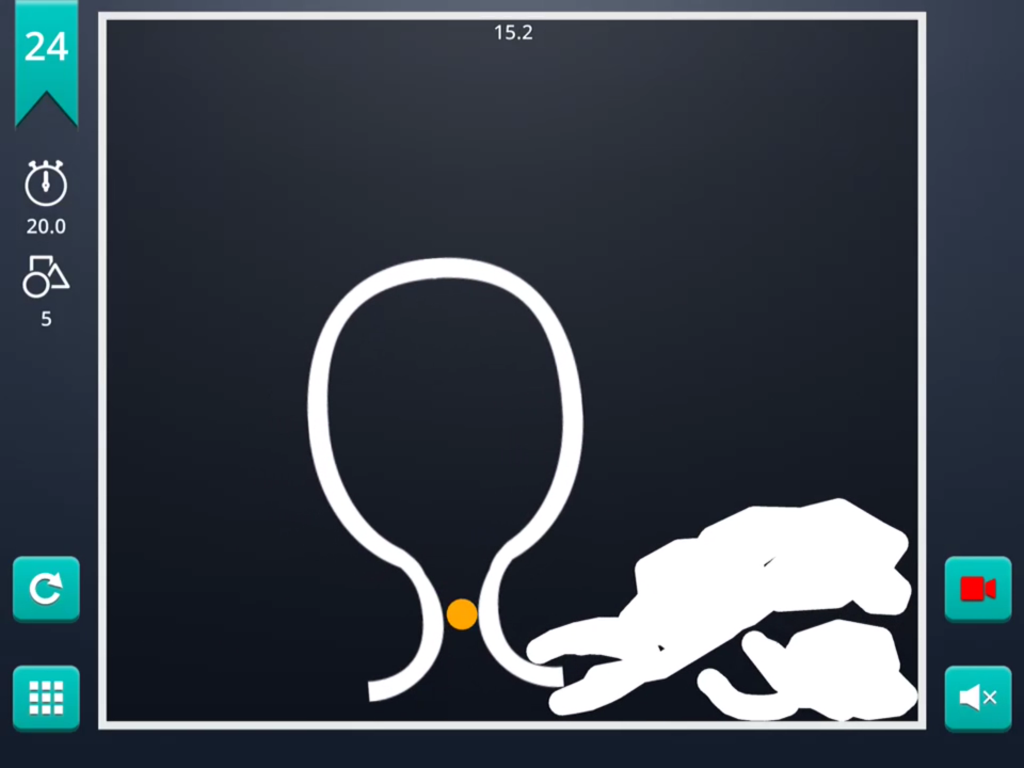
 I am intrigued by how elements of gamification in this app stand in stark contrast to many classroom experiences. According to Oxarart et al., “Our current system [of education] is de-motivating because we tell our kids that they all “start with an A” but then with each successive failure or poor grade, they move further and further away from that ‘A.’… Game design principles reverse that by having students always adding points and working towards specific goals or levels” (Oxarart et al., 2014, p. 349). “Brain It On”, and others like it, provide graduated problem-solving experiences. Players are rewarded with points and newly unlocked levels as they complete each task.
I would like to believe that I am actually breaking trend from the classrooms that Oxarart refers to. I make use of case studies and inquiry where there is no single “right answer”; by using outcome based assessment, I permit students as many attempts as they wish at achieving each outcome; and there is no penalization for making mistakes—instead these are seen as opportunities to learn something new, and try again.
Notably, the hardest students to convince in these approaches are the grades 11 and 12 students who have become confined by the system of education. They are constantly looking for the easy answer and an update on their percentage.
So, in my class, I am forcing them out of their comfort zone. As I challenged my students to build a rice harvester using a mousetrap, I couldn’t help but smile—I was gamifying their learning. My students were not playing Portal 2 as in the study by Shute et al., but they were using
- rule application (solving problems by applying existing rules)
- problem decomposition (determining the goals, sub-goals, and individual steps of the problem)
- flexibility (i.e., using tools in novel ways), and
- resource management (i.e., effective and efficient allocation of resources). (Shute et al., 2015, p.60)
So, my Adventure in Gaming II, has been an encouraging one. I realized that I just might be more cutting-edge than I thought. My classroom practice certainly aligns more closely with events I’ve heard describe in reference to Portal 2, than with those happening in many classrooms.
I suppose I will find out…I couldn’t stand the suspense any longer so I paid my $22 for a chance to play it myself. So, Brain Bring It On!..Adventures in Gaming III…Portal 2…Tune in next time for an update.

References
Oxarart, A., Weaver, J., Al-Bataineh, A., & Al Bataineh, M. T. (2014). Game Design Principles and Motivation. International Journal of Arts & Sciences, 7(2), 347–359. Retrieved from http://search.proquest.com.qe2a-proxy.mun.ca/docview/1644633249/abstract/A0B63A69D5244CD9PQ/1
Shute, V. J., Ventura, M., & Ke, F. (2015). The power of play: The effects of Portal 2 and Lumosity on cognitive and noncognitive skills. Computers & Education, 80, 58–67. https://doi.org/10.1016/j.compedu.2014.08.013
Simpson, E. S. (2005). What Teachers Need to Know about the Video Game Generation. TechTrends: Linking Research & Practice to Improve Learning, 49(5), 17–22. Retrieved from http://search.ebscohost.com/login.aspx?direct=true&AuthType=ip,url,uid&db=aph&AN=19511589&site=ehost-live&scope=site
Adventures in Gaming #1
I am a member of the Pac Man generation, but I never understood the mania. My attitude towards games has usually been one of non-interest, even disdain. Even as I realized I was obligated to spend a minimum of 2-3 hours a week playing digital games, I groaned a little. There must be something in gaming though. My own children border on obsession when it comes to games, spending hours playing Call of Duty, Smash Bros., or FIFA16. So, I wondered, “What elements of gaming actually motivate players?” Barzilai and Blau write, “Games draw much of their unique instructional potential by offering learning experiences that are motivating, engaging, and enjoyable for learners” (2014, p.67). If a game is not motivating, engaging nor enjoyable then what is the point? Is it even a game? How could it possibly offer a learning experience?
With a little resistance I picked up the PlayStation controller, downloaded some new applications on my iPad and did my best to have a positive attitude. I started with Call of Duty and lasted about 3-minutes and was ready to give up. I realized that for many students who struggle with learning there is always the temptation to give up when failing. It is called “learned helplessness”. Walling and Martinek write, “One of the main causes of learned helplessness is repeated failure in numerous achievement situations. For many children, the school setting has been a prime ‘breeding ground’ for failure experiences” (1995, p.454). I felt the same way about digital games. But, I suspected that all games might not be created equally, and not all games were optimized for all players.

Figure 1: Typical crash scene while playing Mario Kart
My next game selection was Super Mario Kart (Figure 1) where my experience was no different than Call of Duty. I wondered how a guy with a 30-year accident-free driving record could be so horrible at a driving game and I wondered about the transferability of skills between virtual and real environments. Neulight et al. suggest the necessity of scaffolding and teacher facilitation, to transfer digital game experiences into practice in the real world (2014). I wonder what I would have to do to transfer my spotless driving record into a digital game like Mario Kart.

 Figure 2/3: Story line of Uncharted is engaging.
Uncharted (Figure 2 and ) and Triple Town (Figure 4) provided a different experience for me. These game choices were suggested by friends when I shared about my gaming struggles. These friends know me well, and recognized that logic and problem-solving were elements I would enjoy in a gaming experience. They were right. I realize that one of the great potentials of gaming for learning is the customization of the playing experience, both in game selection as well as player decision-making within game scenarios. Newman and Case write, “students learn to take charge of their learning: they learn to use what they know…to make thoughtful decisions” (2014, p. 21).
 Figure 4: Triple Town is built on a simple concept, but has elements of a great strategy game.
References
Barzilai, S., & Blau, I. (2014). Scaffolding game-based learning: Impact on learning achievements, perceived learning, and game experiences. Computers & Education, 70, 65–79. Retrieved from https://doi.org/10.1016/j.compedu.2013.08.003
Neulight, N., ninaweb@ucla.ed., Kafai, Y., Kao, L., Foley, B., & Galas, C. (2007). Children’s Participation in a Virtual Epidemic in the Science Classroom: Making Connections to Natural Infectious Diseases. Journal of Science Education & Technology, 16(1), 47–58. https://doi.org/10.1007/s10956-006-9029-z
Newman, G., & Case, R. (2014). Opportunities and Challenges in a Digital Age. In Creating thinking classrooms: Leading educational change for a 21st century world. Vancouver, British Columbia: The Critical Thinking Consortium. Retrieved from https://tc2.ca/uploads/PDFs/Sample%20lessons/CTCChapterOne.pdf
Walling, M. D., & Martinek, T. J. (1995). Learned Helplessness: A Case Study of a Middle School Student. Journal of Teaching in Physical Education, 14(4), 454–466. Retrieved fromhttp://search.ebscohost.com/login.aspx?direct=true&AuthType=ip,url,uid&db=s3h&AN=20752008&site=ehost-live&scope=site